
- Ear, Nose & Throat
Ear
Nose
- Head & Neck
- Contact Us
- Ear, Nose & Throat
Ear
Nose
- Head & Neck
- Contact Us
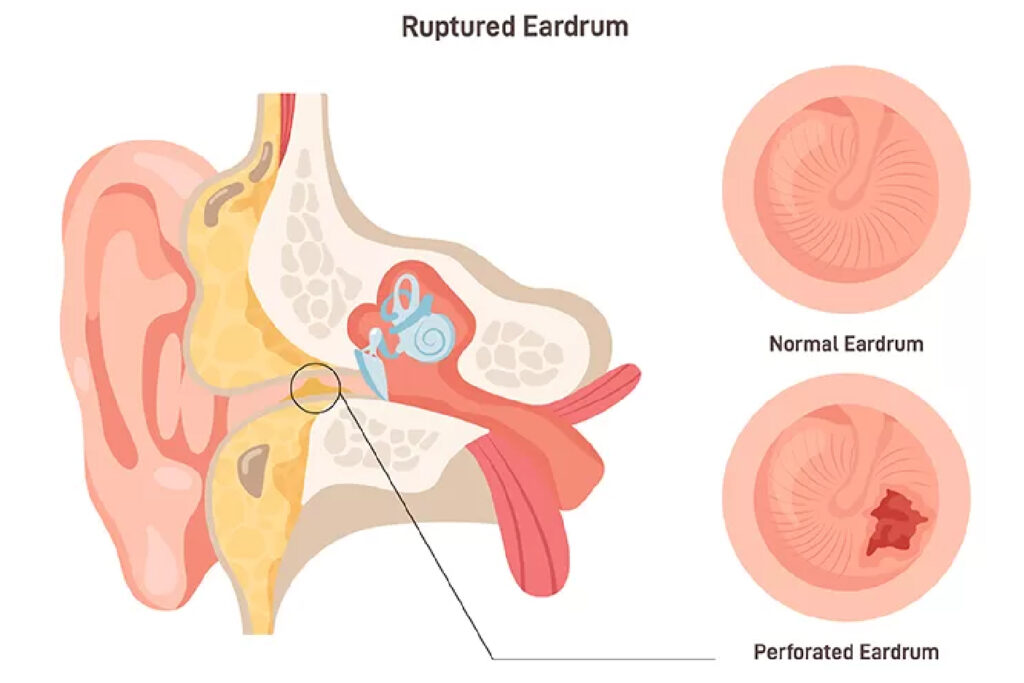
A ruptured eardrum, also known as a perforated eardrum or tympanic membrane perforation, is a tear or hole in the thin membrane that separates the ear canal from the middle ear. The eardrum plays an essential role in hearing by vibrating in response to sound waves and helping convert them into signals the brain can interpret. It also acts as a protective barrier, preventing water, bacteria, and other contaminants from entering the middle ear. When the eardrum is damaged, both hearing and ear protection can be affected.
A rupture of the eardrum can occur for several reasons, including:
At ENT Specialists of Alberta, our experienced team provides expert evaluation and treatment for ruptured eardrums for patients across Alberta. Early assessment can help protect hearing and support proper healing.
In many cases, people notice that something feels wrong with their ear or hearing. However, it is also possible to have a ruptured eardrum without immediately realizing an injury has occurred.
A ruptured eardrum may cause a sudden sharp pain in the ear. In some situations, especially when a middle ear infection is present, people may instead feel a sudden relief of pain as pressure and fluid are released from the middle ear.
Fluid drainage from the ear canal is another common symptom. This drainage may appear clear, pus-like, or tinged with blood.
Because the eardrum plays a key role in hearing, hearing changes are common. This may range from mild muffling of sounds to more significant hearing loss in the affected ear. Some individuals also experience tinnitus, which may sound like ringing, buzzing, clicking, or roaring in the ear without an external source.
When the protective barrier between the ear canal and the middle ear is disrupted, the risk of repeated ear infections increases. A ruptured eardrum may also be associated with dizziness or vertigo, sometimes accompanied by nausea or vomiting. Fever or an elevated body temperature can also occur, particularly if an infection is present.
At ENT Specialists of Alberta, our team provides expert assessment and care for patients across Alberta experiencing symptoms of a ruptured eardrum. Early evaluation can help guide treatment and support proper healing.
A ruptured eardrum is typically diagnosed by an ear nose and throat specialist using an otoscope to closely examine the eardrum. Additional tests may be recommended to determine the cause of the injury, assess hearing changes, or identify the presence of a middle ear infection.
In most cases, a ruptured eardrum heals on its own within two to three months. During the healing process, your doctor may prescribe antibiotics, either as ear drops or oral medication, to treat an existing infection or help prevent one from developing while the eardrum heals itself.
While your eardrum is healing, it is important to follow these care guidelines:
If ear pain or discomfort is present, over-the-counter pain relief medications such as ibuprofen or acetaminophen may be recommended.
If the eardrum does not heal on its own, your ear nose and throat specialist may suggest further treatment. One option is an eardrum patch, also known as myringoplasty. This procedure involves placing a small patch over the perforation to encourage healing and can often be performed in the clinic using local anesthesia.
In cases where myringoplasty is not suitable or has not been successful, surgery may be recommended. Tympanoplasty is a surgical procedure used to repair larger or more complex eardrum tears, particularly when the perforation involves the edge of the eardrum or when chronic ear infections are present. This procedure is typically performed as a day surgery under general anesthesia and usually takes two to three hours. A small piece of tissue from the body is used to repair the tear and restore the integrity of the eardrum.
At ENT Specialists of Alberta, our experienced team provides comprehensive care for patients across Alberta with ruptured eardrums, focusing on hearing preservation and long term ear health.
Although many ruptured eardrums heal without complications, prevention is always the best approach. Taking a few simple precautions can help protect your ears and reduce the risk of injury.
To help prevent a ruptured eardrum, consider the following:
If the eardrum does not heal on its own, your ear nose and throat specialist may suggest further treatment. One option is an eardrum patch, also known as myringoplasty. This procedure involves placing a small patch over the perforation to encourage healing and can often be performed in the clinic using local anesthesia.
In cases where myringoplasty is not suitable or has not been successful, surgery may be recommended. Tympanoplasty is a surgical procedure used to repair larger or more complex eardrum tears, particularly when the perforation involves the edge of the eardrum or when chronic ear infections are present. This procedure is typically performed as a day surgery under general anesthesia and usually takes two to three hours. A small piece of tissue from the body is used to repair the tear and restore the integrity of the eardrum.
At ENT Specialists of Alberta, our experienced team provides comprehensive care for patients across Alberta with ruptured eardrums, focusing on healing, hearing preservation, and long term ear health.
If you are experiencing symptoms of a ruptured eardrum or have concerns about ear injury, contact ENT Specialists of Alberta to schedule a consultation and receive expert care.
Discover comprehensive ENT care with our network of experienced providers across multiple convenient locations. From routine check-ups to specialized treatments, we’re here for all your ear, nose, and throat needs.